Monday, 2 October 2017
Reflection is the adjustment in heading of a wavefront at an interface between two unique media with the goal that the wavefront returns into the medium from which it started. Basic cases incorporate the impression of light, solid and water waves. The law of reflection says that for specular reflection the point at which the wave is occurrence at first glance squares with the edge at which it is reflected. Mirrors show specular reflection.
In acoustics, reflection causes echoes and is utilized as a part of sonar. In geography, it is critical in the investigation of seismic waves. Reflection is seen with surface waves in waterways. Reflection is seen with many sorts of electromagnetic wave, other than obvious light. Impression of VHF and higher frequencies is critical for radio transmission and for radar. Indeed, even hard X-beams and gamma beams can be reflected at shallow edges with uncommon "brushing" mirrors.


In acoustics, reflection causes echoes and is utilized as a part of sonar. In geography, it is critical in the investigation of seismic waves. Reflection is seen with surface waves in waterways. Reflection is seen with many sorts of electromagnetic wave, other than obvious light. Impression of VHF and higher frequencies is critical for radio transmission and for radar. Indeed, even hard X-beams and gamma beams can be reflected at shallow edges with uncommon "brushing" mirrors.
Impression of light is either specular (reflect like) or diffuse (holding the vitality, however losing the picture) contingent upon the idea of the interface. In specular reflection the period of the pondered waves depends the decision of the root of directions, however the relative stage amongst s and p (TE and TM) polarizations is settled by the properties of the media and of the interface between them.[1]
A mirror gives the most well-known model to specular light reflection, and commonly comprises of a glass sheet with a metallic covering where the noteworthy reflection happens.
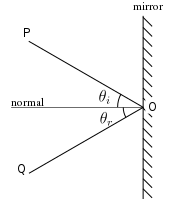
Reflection is improved in metals by concealment of wave engendering past their skin profundities. Reflection likewise happens at the surface of straightforward media, for example, water or glass.In the chart, a light beam PO strikes a vertical mirror at point O, and the reflected beam is OQ. By anticipating a nonexistent line through direct O opposite toward the mirror, known as the ordinary, we can gauge the point of occurrence, θi and the edge of reflection, θr. The law of reflection expresses that θi = θr, or as such, the edge of frequency breaks even with the edge of reflection.
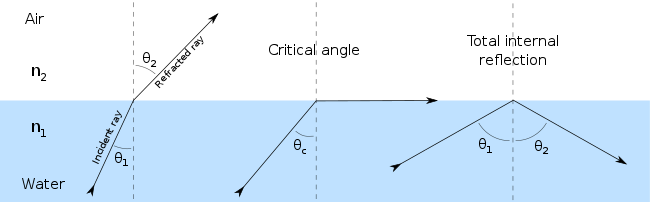
Truth be told, impression of light may happen at whatever point light goes from a medium of a given refractive record into a medium with an alternate refractive list. In the most broad case, a specific part of the light is reflected from the interface, and the rest of refracted. Settling Maxwell's conditions for a light beam striking a limit permits the inference of the Fresnel conditions, which can be utilized to anticipate the amount of the light is reflected, and what amount is refracted in a given circumstance. This is closely resembling the way impedance jumble in an electric circuit causes impression of signs. Add up to interior impression of light from a denser medium happens if the edge of occurrence is more prominent than the basic point.
Add up to inside reflection is utilized as a methods for centering waves that can't successfully be reflected by normal means. X-beam telescopes are developed by making a merging "passage" for the waves. As the waves interface at low edge with the surface of this passage they are reflected toward the concentration point (or toward another connection with the passage surface, in the long run being coordinated to the locator at the core interest). A customary reflector would be futile as the X-beams would essentially go through the planned reflector.
If the reflecting surface is very smooth, the reflection of light that occurs is called specular or regular reflection. The laws of reflection are as follows:
- The incident ray, the reflected ray and the normal to the reflection surface at the point of the incidence lie in the same plane.
- The angle which the incident ray makes with the normal is equal to the angle which the reflected ray makes to the same normal.
- The reflected ray and the incident ray are on the opposite sides of the normal.
These three laws can all be derived from the Fresnel equations.
which is depicted by Maxwell's conditions. Light waves occurrence on a material initiate little motions of polarization in the individual iotas (or swaying of electrons, in metals), making every molecule transmit a little auxiliary wave every which way, similar to a dipole reception apparatus. Every one of these waves signify give specular reflection and refraction, as per the Huygens– Fresnel rule.
On account of dielectrics, for example, glass, the electric field of the light follows up on the electrons in the material, and the moving electrons produce fields and turn out to be new radiators. The refracted light in the glass is the mix of the forward radiation of the electrons and the episode light. The reflected light is the blend of the regressive radiation of the majority of the electrons.


Good
ReplyDelete